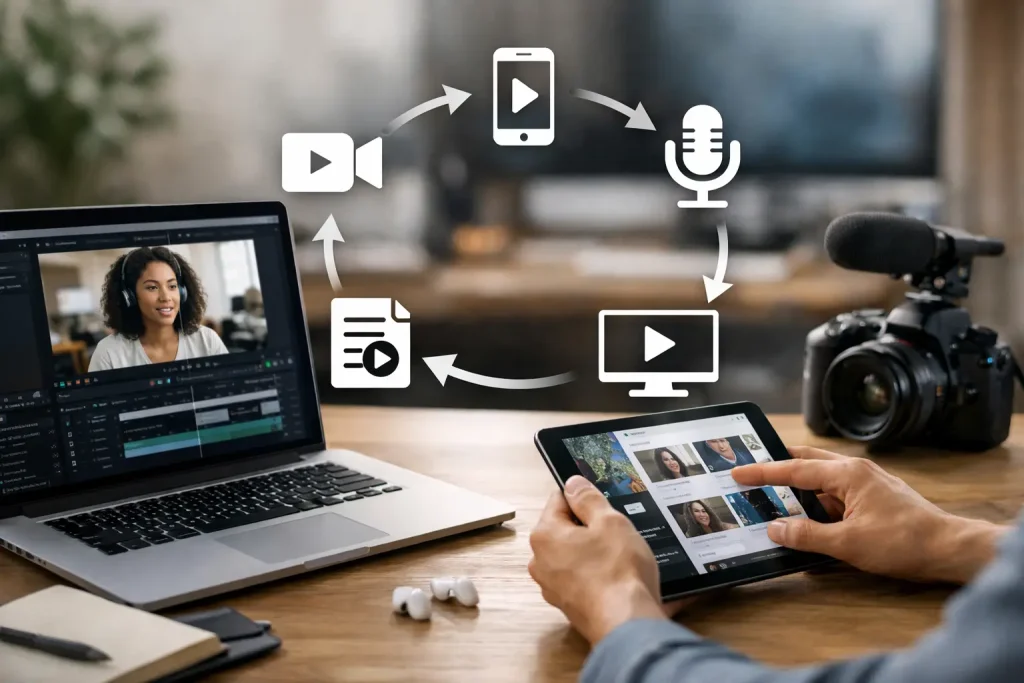

Most people do not need to create more content. They need to stop treating every video like a one-time event. If you repurpose video content with a clear plan, one helpful recording can support your blog, email list, social posts, and affiliate promotions for weeks.
That matters when you are building an online business around a job, family, or limited energy. Recording a new video every day is not a strategy if it leaves you with no time to build an email list, learn your offer, or follow up with people. The goal is not to be everywhere. The goal is to make each piece of work pull more weight.
Why One Video Should Not Be One Piece of Content
A video often contains more value than the platform gives it credit for. A five-minute explanation of a beginner mistake can become a short clip, a practical blog post, an email lesson, a carousel, and a discussion prompt. The core idea stays the same, but the format meets people where they prefer to learn.
Some people will watch a full video. Others will read an article during a lunch break, save a short clip, or open an email because it arrived at the right moment. You are not repeating yourself in a lazy way. You are giving a useful message more than one chance to be seen.
This is especially useful for affiliate marketers. You do not need a giant audience before you can get results. You need consistent, relevant traffic and a simple path from content to your email list or recommended offer. Repurposing helps you stay visible without constantly scrambling for the next topic.
There is a trade-off. Repurposing weak content only creates more weak content. Start with videos that solve a specific problem, answer a real question, or explain one step your audience needs next. Broad motivational talk may get attention, but practical content is easier to turn into assets that continue working.
Start With Videos That Have a Clear Job
Before you record, decide what the video is supposed to do. Trying to teach everything about affiliate marketing in one video usually creates a rambling mess that is hard to reuse. A focused video gives you cleaner clips, stronger headlines, and a clearer next step.
A useful video might address why beginners keep switching affiliate programs, how to choose one traffic source, what to send in a first welcome email, or how to promote an offer without sounding desperate. Each topic can lead naturally to additional content and a relevant call to action.
Use a simple structure: name the problem, explain why it happens, give a practical fix, and tell the viewer what to do next. That next action might be joining your list for a checklist, reading a related post, or learning more about a training program that fits the problem. Do not force an offer into every sentence. Make the recommendation fit the lesson.
A ten- to fifteen-minute video is often enough for one strong topic. You can work with shorter videos too, but a detailed recording usually gives you more material to turn into written content. The point is not the length. The point is having enough substance to be useful in several formats.
How to Repurpose Video Content Without Creating Busywork
The fastest approach is to build a repeatable workflow. Record once, then turn the recording into a small content package. Do not decide from scratch what to do with every video. Decision fatigue is one reason people abandon consistency.
Start by creating a transcript. You can use an AI transcription tool, but do not publish the raw transcript as a blog post. Spoken language includes filler, repeated phrases, incomplete thoughts, and side comments that may work on camera but read poorly on a page.
Edit the transcript into an article built around the viewer’s main problem. Give it a strong headline, add helpful subheadings, and tighten the explanation. If your video explains how to choose a niche, the article should not simply repeat every word. It should organize the ideas so a reader can scan the decision points and take action.
Next, pull out two or three short clips. Look for moments that make one clear point in 20 to 60 seconds. A good clip can challenge a common bad habit, answer one beginner question, or share a quick example. Add captions because many people scroll with the sound off, and make the opening line direct enough to stop the scroll.
Then write an email from one idea in the video. Do not try to summarize the entire recording. Pick the most useful lesson and expand it with a short story, example, or warning. If the video is about free traffic, your email could focus on the mistake of posting everywhere instead of committing to one channel long enough to learn what works.
Finally, create a few simple social posts from the same topic. One post can state the main lesson. Another can address an objection. A third can share a mistake you see beginners make. These are not copies of the video. They are entry points that lead people back to your larger message.
Match the Format to the Platform
Not every platform needs the same version of your message. A blog post should go deeper and answer the question thoroughly. It can attract search traffic over time, which makes it valuable for a site you control.
Short-form social content needs a sharper angle. It should earn attention quickly, then point people toward the next useful step. Your email should feel more personal and direct. It is where you can explain the consequence of a problem, build trust through consistent teaching, and invite subscribers to take action.
This is why owned assets matter. A social platform can limit reach or change its rules whenever it wants. Your email list and website are business assets you can continue building on. Use short clips and posts to start conversations, but make sure your system has a path toward your list.
For example, a video about finding an affiliate offer can become a blog article on evaluating beginner-friendly offers, a short clip about avoiding high-commission traps, and an email about why a product is not worth promoting if you cannot explain its benefit clearly. The common thread is one audience problem. The call to action can guide interested people toward your chosen resource or training.
Do Not Let Repurposing Become Another Distraction
The danger is turning a smart strategy into a complicated content factory. You do not need 27 assets from every video. That kind of system looks productive but often causes beginners to quit after two weeks.
Choose the formats that match your current business goal. If you need search traffic, prioritize video-to-blog content. If list building is your priority, create the video, an email, and a simple lead magnet connected to the topic. If you are building awareness on one social platform, focus on a few clips and posts rather than trying to publish everywhere.
Keep a content tracker with the video topic, the problem it solves, its call to action, and each version you created. This prevents you from posting random advice that does not connect to anything. It also shows you which ideas deserve another round of promotion because they generated replies, clicks, subscribers, or sales.
Pay attention to what performs, but do not overreact to one post. A short clip with lots of views is not automatically a business win if it attracts people who never join your list or care about your offer. A smaller post that brings engaged subscribers can be far more valuable.
Build a Weekly Repurposing Rhythm
A simple schedule beats a perfect plan you never follow. Choose one topic each week based on a question your audience keeps asking or a problem connected to your current offer. Record the video, clean up the transcript into an article, make two short clips, and send one email built around the strongest point.
That is enough. After several weeks, you will have a library of videos, articles, emails, and social content that all reinforce your message. You will also get better at recognizing which problems bring the right people into your business.
You are not trying to look like a full-time media company. You are building a practical content system that respects your time and gives every useful idea more than one opportunity to create traffic, trust, and income. Start with your next video, give it one clear job, and make it work long after you stop recording.